Why Senior Developers Are Actually Thriving With AI (While Everyone Else Worries)
Deep experience turns out to be the best preparation for working with AI. Here is why senior developers are adapting faster than anyone else.
- filed
- 2025·10·01
- ref
- NOTE·007
- tags
- ai · dev · career · engineering
- by
- A.T.

What deep experience taught me about adapting to AI faster than anyone else.
If there’s one thing I’ve noticed in the past year, it’s this:
The most anxious people about AI aren’t junior developers. They’re mid-career developers.
The most relaxed? The senior developers who’ve been around longer.
It’s the opposite of what you’d expect.
I thought about this for a while, and then it clicked. Senior developers have seen more paradigm shifts. They’ve adapted before. They know that “everything changing” is actually normal in software engineering.
But there’s something else: senior developers understand something that newer developers haven’t learned yet.
They understand that their value was never about syntax or typing speed. It was about judgment.
And AI hasn’t touched judgment. It’s only made judgment more valuable.
Let me explain what I mean.
What Changed, What Didn’t
Here’s the thing about working in software for a long time.
You see patterns repeat.
Waterfall gave way to Agile. On-premises gave way to the cloud. Monoliths gave way to microservices. Each time, the same anxiety: “This changes everything. My skills are obsolete.”
Each time, it turned out to be wrong.
Not because the change wasn’t real. It was. Each of those transitions legitimately changed how we build software.
But the developers who thrived in each transition understood something: The tools change. The thinking doesn’t.
When we moved from waterfall to agile, developers didn’t stop needing to understand architecture. We just got feedback faster.
When we moved to the cloud, developers didn’t stop needing to understand performance. We just had different constraints.
The same is true with AI.
AI changes the tools. It doesn’t change the fact that you need to make good architectural decisions. You still need to think about edge cases. You still need to understand your users’ needs. You still need to know what “good” looks like.
Senior developers get this intuitively. Younger developers have to learn it.
The Experience Advantage
Here’s what senior developers have that nobody else does: pattern recognition built from experience.
A senior developer has seen:
20 authentication systems (knows which ones fail and why)
50 database designs (knows the trade-offs of each approach)
100 API designs (knows what becomes a problem at scale)
Dozens of teams go through paradigm shifts (knows what works, what doesn’t)
Multiple languages, frameworks, platforms (knows that tooling is temporary, thinking is permanent)
This experience is actually an advantage now.
Because when you’re working with AI, the biggest risk isn’t that the code is bad. It’s that the approach is wrong.
A junior developer asks AI: “Build me a real-time notification system.”
AI generates something using WebSockets. It works.
But a senior developer who’s seen three real-time notification systems fail at scale knows to ask:
What’s our user load?
How many concurrent connections can we handle?
What happens when the server goes down?
Do we need persistence?
What about rate limiting?
How do we handle slow clients?
These questions aren’t about code. They’re about architecture.
And they’re the questions that separate “works in development” from “works at scale.”
The senior developer asks these questions before asking AI to code. The junior developer asks AI first, then realizes 80% of the code doesn’t fit the actual requirements.
The Judgment Moat
This is the key insight: As AI gets better at code, judgment becomes more valuable.
Because anyone can generate code now. The differentiator is whether the code solves the right problem, in the right way, with the right trade-offs.
That’s judgment. And judgment comes from experience.
A senior developer with deep experience has something AI can never have: context built from years of software history.
You’ve seen what works and what doesn’t. Not from reading about it. From doing it.
AI can generate code. It can’t accumulate years of “oh, don’t do that, I’ve seen it fail three times.”
This is what makes senior developers valuable. Not their ability to type fast. Never was. Always been judgment.
And now that typing is automated, judgment is literally the only thing that matters.
Why Senior Developers Are Thriving
Let me walk through what I’m seeing senior developers do with AI:
They don’t abdicate thinking to AI. They amplify it.
A senior developer doesn’t say “AI, build me the system.” That’s how you fail.
A senior developer says: “Here’s the system I’ve designed. Here’s what I need in component A. Generate it with these constraints.”
They hand AI a problem that’s already been thought through. AI generates the solution. They review it for fit and edge cases. Done.
They review strategically, not paranoidly.
They don’t review every line for syntax. They review for judgment: “Does this match what I intended? What am I not seeing? What could break?”
Years of experience teaches you what to look for. You’re not checking if the code works. You’re checking if the code is right.
They know what to ask for.
When they prompt AI, they’re specific. Not because they’re naturally better at writing prompts. But because years of experience teaches you that vague requirements produce bad outcomes.
So they specify clearly. They give context. They ask for what they actually need.
And they get it in one or two iterations instead of ten.
They know how to fold AI into their workflow without losing control.
A senior developer knows the biggest risk with AI isn’t speed. It’s loss of judgment.
So they structure their workflow to keep judgment in place:
I decide the architecture
AI generates the implementation
I validate it matches my architecture
I check for the edge cases I know matter
We ship
This keeps them in control while letting AI handle the heavy lifting.
They understand that this is just another shift.
They’ve seen platforms change, languages change, frameworks change. They’ve always adapted.
They’re not panicked about AI because they know how to adapt. It’s a skill they’ve practiced throughout their career.
The Threat Isn’t What You Think
Here’s what keeps most developers up at night: “AI will replace me.”
Here’s what senior developers understand: The thing that makes you valuable isn’t replaceable.
If your value was “I can type code fast,” yeah, AI is a threat. But your value was never just that. If it was, you wouldn’t have lasted 15 years.
Your value is judgment. Architecture. Understanding context. Mentoring others. Making hard trade-off decisions.
AI can’t do any of that.
The real threat is different: The developers who learn to work with AI effectively will outpace those who don’t.
That’s not AI replacing anyone. That’s a new skill set separating winners from everyone else.
And guess who already has 90% of the skills needed to master the new skill set?
The senior developers.
Because half of what you need (thinking clearly, making architectural decisions, understanding constraints) you’ve been doing throughout your career.
The new skill is just: “Let AI handle the typing. You focus on what you’ve always been good at.”
The Path Forward
If you’re a senior developer and you’re nervous about AI, here’s what I’d tell you:
You’re in the best position of anyone to thrive with this shift.
Because this shift isn’t about coding better. It’s about leveraging judgment more.
And judgment is exactly what you’ve spent your career building.
The developers who will struggle are the ones who:
Try to compete with AI on typing speed
Abdicate thinking to AI
Refuse to change their workflow
The developers who will thrive are the ones who:
Use AI as a tool to amplify their thinking
Keep their judgment central to the workflow
Understand that they’re orchestrating, not typing
You already know how to do this. You just need permission to admit that your value was never the typing.
It was always the thinking.
What This Means for Teams
If you’re leading senior developers, here’s what I’d tell you:
You have an advantage. Senior developers have the mental models and experience to adapt quickly to AI-integrated workflows.
Invest in helping them:
Understand that their judgment is more valuable than ever
Learn to work with AI effectively (prompting, validation, iteration)
Become the mentors who teach the rest of your organization how to do this
The senior developers who master this workflow will become the force multipliers of your organization.
They’ll be able to:
Ship 10x faster (because they know what matters)
Maintain quality (because they know what to validate)
Mentor others (because they understand the shift)
Lead technical decisions (because they have the context)
These are the people you want leading your technical future.
The Real Shift
I spent this article talking about why senior developers have an advantage with AI.
But the deeper truth is this:
The shift from “code author” to “orchestrator” is actually a return to what senior developers were always meant to be doing.
The past 20 years of software development has been about optimizing for speed: ship faster, iterate faster, type faster.
We turned developers into typing machines and called it progress.
AI is giving us permission to stop.
To focus on what actually matters: thinking, architecture, judgment, mentoring.
Senior developers have been saying they want to spend more time on these things for years.
AI is finally making that possible.
The developers who will thrive in the next 5 years are the ones who understand that this isn’t a threat.
It’s an opportunity.
I wrote “The Developer’s Playbook for the AI Era” because I wanted to give developers a framework for understanding this shift.
Not just senior developers. All developers.
But I’ll be honest: Senior developers tend to get it faster. They’ve adapted to multiple major shifts already. They know how to think through big changes.
The book walks through:
What’s actually changing (and what isn’t)
How to work effectively with AI without losing control
How to maintain quality while shipping faster
How to lead your team through this transition
Real case studies from senior developers who are already doing this
If you’re a senior developer who’s been worried about AI, this book is the permission slip you’ve been looking for.
Here’s the truth: Your value isn’t threatened. It’s about to become more important than ever.
Minimize image Edit image Delete image
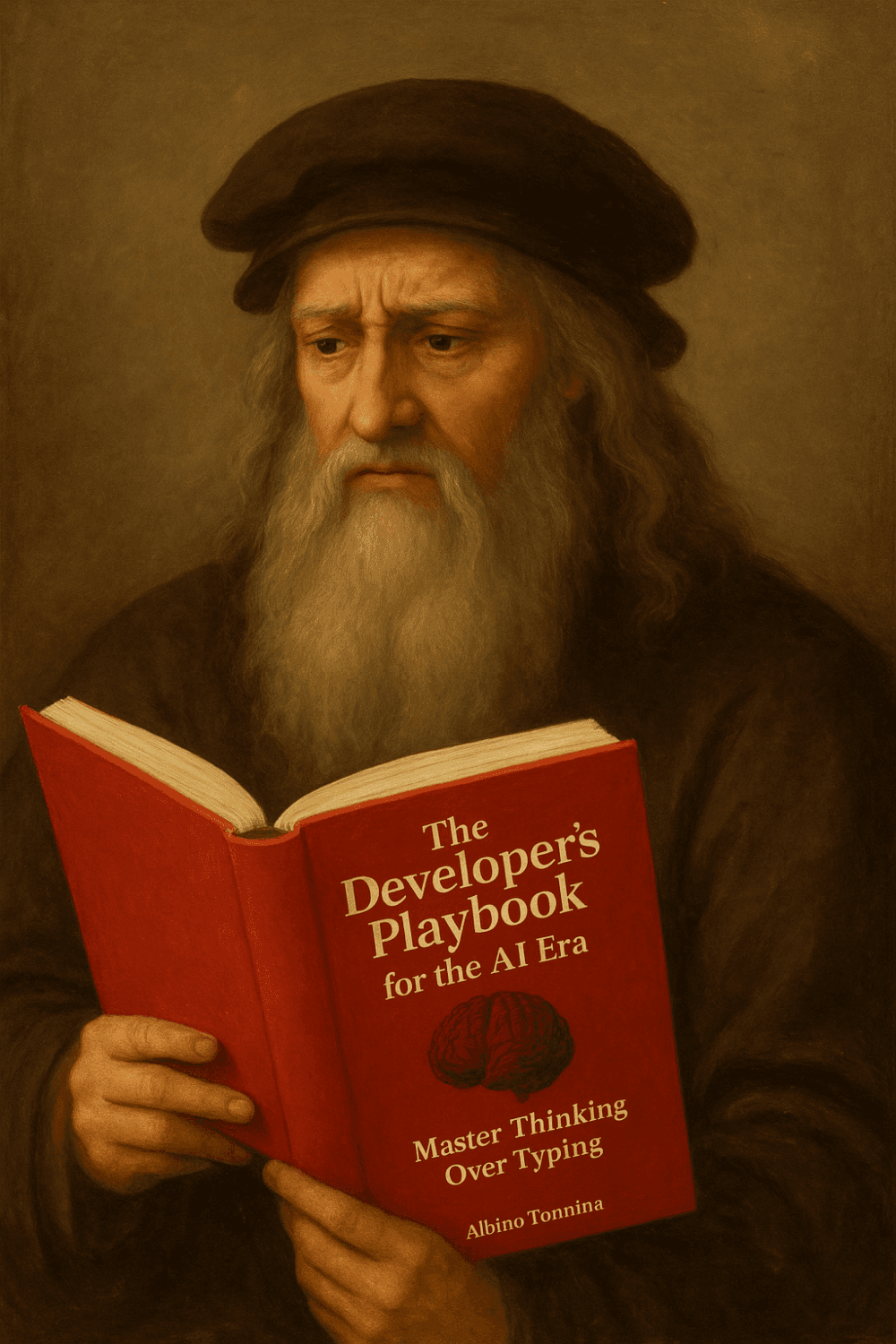
You can grab the book here: https://albinotonnina.com/developer-playbook-ai-era